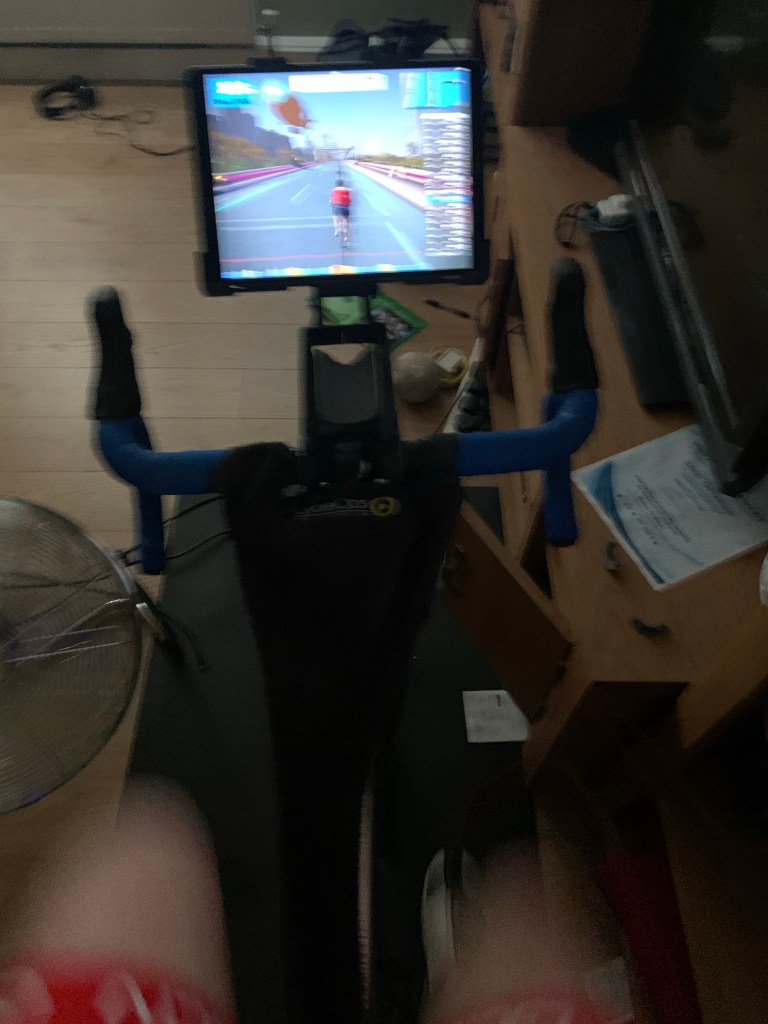
Wowsers, Zwift is a crowded place these days. Since the world went into lockdown and with cycling actively banned in some countries, thousands of frustrated cyclists are flocking to the virtual world of Zwift to get their two wheel based fix of mild nausea and lactic acid. Now there’s literally hundreds if not thousands of really good, well researched tutorials online about how to use and get the best from Zwift by proper YouTube luminaries such as GCN or DC Rainmaker which cover everything from which turbo trainer to use and how to set it up to which climbs on the different worlds are the ones most likely to bring your breakfast back up.
What can I possibly add to this exhaustive resource? Well I do have a few insights for the more casual or dare I say it less serious user, so if you’re just setting out on your Zwift journey and don’t take life and your FTP too seriously feel free to read on ………..
1. A fan is your new best friend!
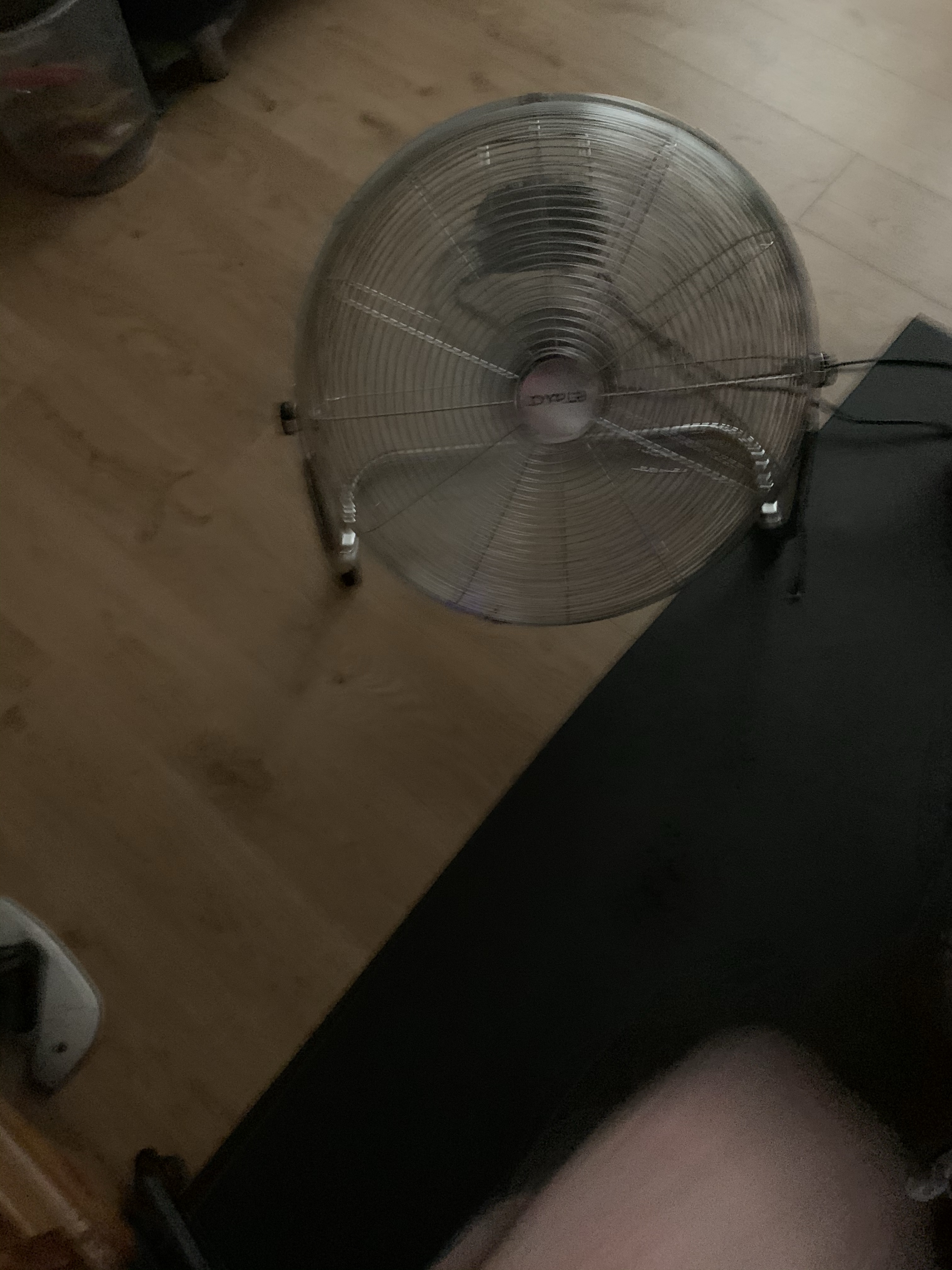
You will sweat, in fact unless you’re a very ginger freckle infested person who’s travelled extensively in South East Asia I’m willing to bet that that churning out the watts on Zwift will be the sweatiest experience of your life. Get a fan, in fact get the biggest fastest spinning fan you can find. If you cant get a big fan steal / beg / borrow every fan you can find in your house and arrange them to blow as much air as possible over your sweating torso. This is my sweat drying weapon of choice – it moves enough air to remove Donald Trumps toupee and makes you feel like your riding into the teeth of a small tornado.
2. Turbo training is noisy – expect complaints from any family members or random people you got stuck in lockdown with if your Zwift set up is sharing the room with the sofa and television. If your house allows set up somewhere as far away from others as it’s possible to get, the garage (if you haven’t converted it into a dining room you never use that is …..) is ideal, or even get a really long extension cord and set up at the furthest point of the garden away from the house. I never really appreciated just how noisy the whole Zwift thing was till my teenage daughter started using it too last week to keep the size of her derrière in check while she eats lots of boyfriend separated comfort food. Even upstairs I was aware of the rumble of the turbo and the whirling of the fan, and my Cyclops trainer is reputed to be one of the quieter ones on the market.
3. Insert the earworm early and embrace it – the dreaded earworm and the turbo for me and many other fellow sufferers go unfortunately hand in hand. You just can’t seem to get one with out the other. Accepting this early is the key to minimising the misery. Trying to impose a song choice on the subconscious only adds to the annoyance – whatever song your random synapses have selected is the one you’ll be stuck with until your brain chooses to switch tracks. On rare occasions the earworm can even be helpful, Sting’s ‘An Englishman in New York” kept me humming away happily as I lapped Central Park last week. At other times it’s just pure torture. Yaz and the Plastic Population with ‘The Only way is Up” had me chewing on the insides of my cheeks all the way up to Watopia’s Radio Tower recently. If you’rea fellow sufferer there really is nothing you can do.
4. There’s lots of numbers and they really don’t matter – Zwift is a numbers geeks dream. Now I’ve never personally been a numbers man. Never owned a power meter, hardly ever remember to strap on my HRM before a ride but riding on Zwift really got me thinking about the numbers game for awhile. Numbers and data are everywhere, scrolling across every corner of the display. Power, heart rate, speed, distance, even estimated time to the top of whatever climb you’re grovelling up and of course that coloured power graph that scrolls across the bottom of the screen, its a veritable feast of data. Of course having all these figures suddenly at ones figure tips is a slippery slope. You go from being a care-free seat of the pants type rider that does everything on feel and intuition to the data obsessed geek that adjusts their saddle height four times a ride to see if it affects their power when riding on the drops. You take an FTP test and although you tell yourself you don’t care about the result, your secretly a bit crushed and start to obsess about how to get that magic number trending upwards. It’s a fast track to madness and misery (unless numbers, data and fiddling with your saddle height make you happy of course). Now, I’m not saying numbers don’t matter at all, to a lot of riders especially those who really want to improve or are training for something specific measuring their performance and the gains from training are important, but the thing is a lot of the numbers on Zwift are total bol*@cks. Your power figures can go up or down 20 or 30 watts just by calibrating your trainer. If like me you ride a Cyclops or Saris trainer they are impossible to calibrate accurately on Zwift anyway due to a software issue. When I upgraded to a wheel off direct drive trainer I instantly lost at least 30 – 40 watts and was minutes slower up nearly every climb compared to the times and figures I was seeing using my more basic wheel on model. In a similar vein Zwift reckons I was doing 80kph downhill without pedalling last week – its not the real world folks. Use the numbers and figures to measure improvement by all means, but only stack the results against those others you measure in the virtual world. Don’t cry yourself to sleep because you thought your FTP was 250 watts per kilo and Zwift only rates you at 210 …… its not an exact science!
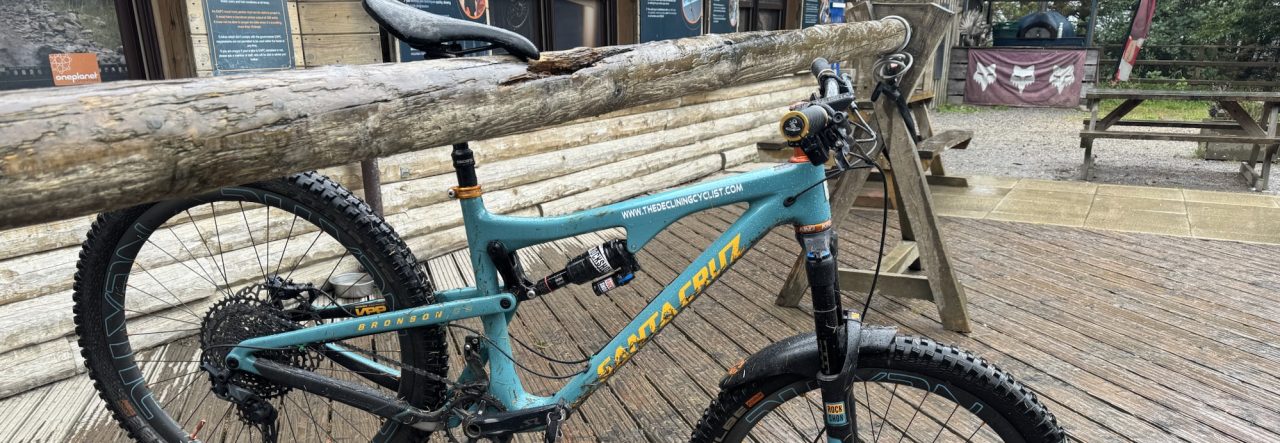
5. Going nowhere fast still wears bits of your bike out ! – since the world went into lockdown I’ve managed previously unthinkable for me amounts of time on the turbo. My back room has seen several hundred kilometres pass beneath my virtual back wheel. Now I don’t know how many revolutions of the cranks that is, but it’s a lot. Towards the end of my last ride I gradually became aware of the sound of mechanical distress coming from underneath me. My poor old bike was reminding me that despite it not moving for a month maybe a bit of care and attention was warranted…… Remember folks, you may not be wearing out your brake blocks or pads, but those chains and cables (if you’re still old fashioned enough to have gear cables!) still need lubing, that bottom bracket is still wearing out and if you have a wheel on trainer keep a close eye on your back tyre and it’s pressure. If you snap your chain during a full out sprint for Zwift glory because it’s drier than a digestive you will still smash delicate bits of yourself into your handlebar stem.
6. Care not what others with seemingly superpowers can do – Zwift can be a throughly demoralising place for the newcomer during those first crucially finding ones bearings type of rides. Literally everyone seems to be going faster than you. Riders with incredible w/kg figures next to their names come screaming past you flinging out ‘Ride on’s’ left, right and centre as they disappear serenely up the road and off the top of your screen. Best advice? Don’t worry about it. You may wonder how it’s humanly possible to ride up some of those climbs literally twice as fast as your best efforts, but just like Strava it’s a waste of effort worrying about it. Set your own goals, make them realistic and achievable and don’t get disheartened when Zwift tells you you’re 537th fastest out of 620 people who have ridden that segment in the last hour.
7. Keep your trainer on the default 50% difficulty setting – unless you are either really fit already or a total masochist (or maybe both) the 50% setting Zwift defaults to is fine for 95% of us mortals. There’s lots of videos and online explanations about how the settings work and it only makes a difference to which gear you need etc. I’m not going to go into that because I can just tell you from bitter experience that the 100% difficulty setting is just unpleasant – try it if you want but you have been warned!
8. There’s a lot of cheats on Zwift racing – again there’s loads on line about this but basically any sport that heavily relies on the honesty of its participants to keep the playing field level will always attract people that want to abuse the system. It’s a bit of a mystery to me, I mean who are these people fooling but themselves ? When I have entered the odd Zwift race I always enter in the lowest category ‘D’ which is supposed to be for riders putting out 0 – 2.5 watts per kilo of weight. Since I put out about 2.2 w/kg on a good day this is where I should be. So whenever I’ve started a Zwift race I’ve watched with mingled annoyance and awe as a good chunk of the riders entered in cat D ride off the front pumping out ridiculously high power numbers. Now I can sustain over 250 watts for awhile but not the duration of a 40 minute race. What these people are trying to achieve who knows? A good number are either disqualified straight after the race or bumped up to a higher category so why do they bother? Is this their self imposed redemption for always being picked last at their school sports day?
9. Your backside will ache more than usual – about an hour is my sweet spot for personal nether regions discomfort on the turbo. Around about the 60 minute mark I find myself starting to do the chamois shuffle as my previously comfy saddle starts to feel like some sort of sadistic torture device and I find myself counting the seconds and kilometres down till whichever ride I’m on is finished. I reckon there’s several reasons for this, indoor riding inevitably is hotter and sweatier than riding outdoors, and you tend to spend most of your time on the indoor trainer locked in pretty much the same position. When we ride on the road we are constantly making little adjustments in body position and weight distribution as we rail the corners or momentarily unweight ourselves as we realise we are inevitably going to have to ride over that pothole. On the turbo in comparison we are pretty static on the bike which (unless your primary riding is time trails in a minimalist skinsuit designed for marginal gains) we are just not used to. There really isn’t a cure for this problem – you just have to accept it as part of the indoor experience and suck it up. Trying to get out of the saddle for awhile on the steep bits and applying a lot of chamois cream pre-ride will help, but not cure this affliction.
10. Remember at some point you will have to use your brakes again – I’m not going to lie, it’s looking pretty grim at the moment. Nobody knows how long the current situation is going to last, or how bad it will get. It’s horrible and there definitely many, many more important things than cycling in the world at the moment. However, there’s little we all can do apart from obeying the lockdown and social distancing instructions and keeping our families and friends as safe as possible. We all have a responsibility to try to come out the other side of this thing in as good a shape as possible mentally and physically so the world can be put to rights as fast as possible. If everyone emerges from their homes in how ever many months time grossly over weight with type 2 diabetes and on the brink of divorce from their spouses that helps nobody. So an hour or so escaping to the virtual world of Zwift is probably a good thing for the cyclist deprived of the open road. Just remember that when we all start to ride outside again there will be cars and vans trying to kill you again, and you will need to use your brakes to slow down!


That’s a top set of tips. I have one of those fans too, they certainly move some air!!!
LikeLike